
Some observations I found interesting that I thought I would share.
I have no background in anything related to cosmology, physics, astronomy, or space exploration. I’m a retired accountant.
Because of this group, I now explore space from my computer.
Enceladus — about 800 million miles away and 25 times smaller than Earth — has captured the imaginations of planetary scientists searching for life beyond the blue marble. Its constant volcanic spray creates a misty halo in space, which contributes to Saturn’s rings.

A study of the moon using the James Webb Space Telescope, a collaboration of NASA and the European and Canadian space agencies, has provided new insight into how it supplies water for the entire Saturnian system. Scientists hope such research will help them better understand the ocean world’s potential for hosting microscopic life.
The James Webb Space Telescope (JWST) is revolutionizing our understanding of the early universe. With a mirror larger than Hubble and the ability to observe deep into the infrared, JWST is giving us a detailed view of that period of the universe when galaxies were just starting to form. The results have been surprising, leading some to argue that they disprove the big bang. But the big bang is still intact, as a recent study shows.
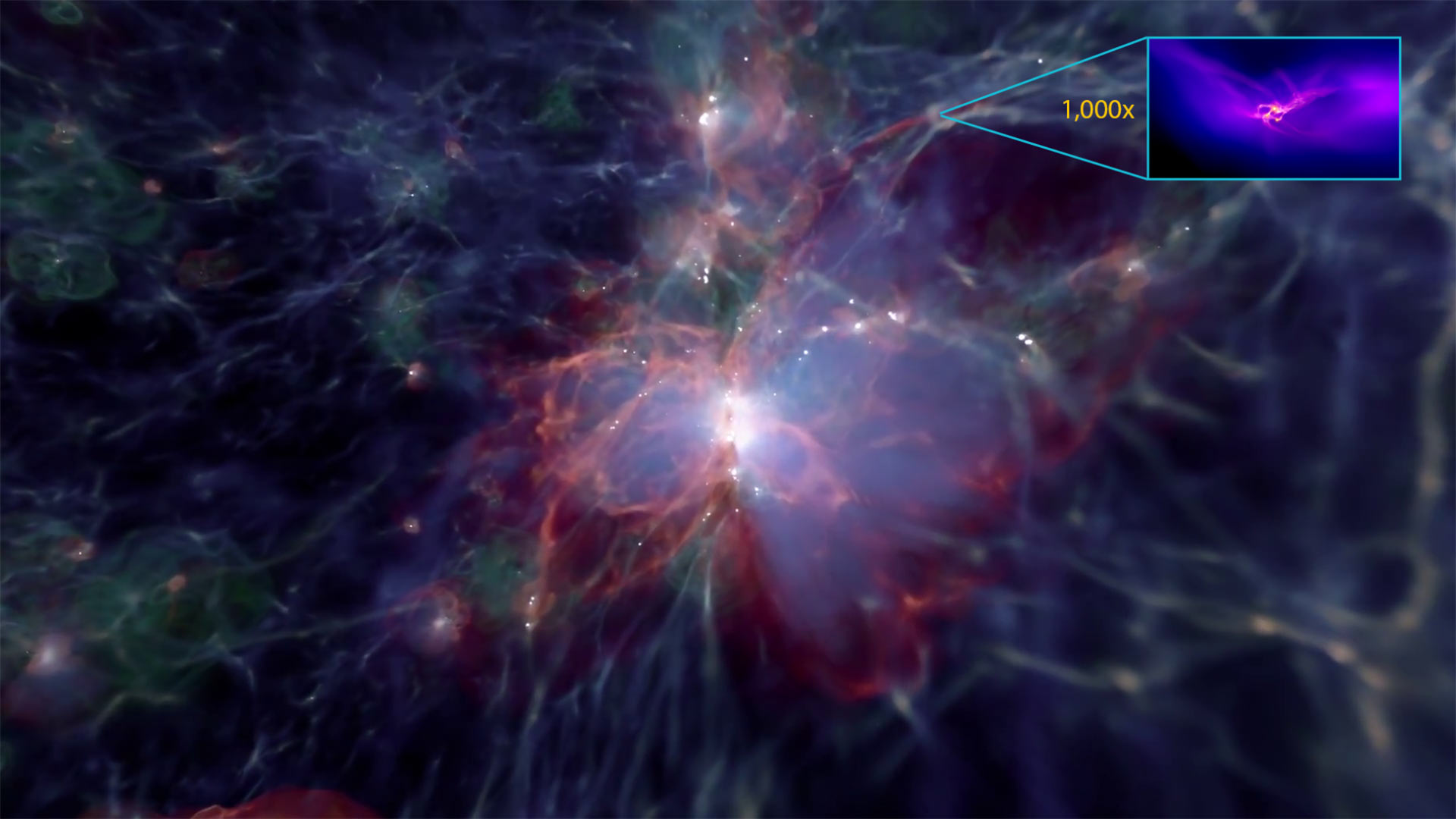
The standard big bang model for cosmology is the LCDM model, which is a universe driven to expand through dark energy (represented by Lambda in the equations), and filled with cold dark matter (CDM). It is the model most strongly supported by observational evidence thus far. But one of the things LCDM seemed to predict was that early galaxies should be small and irregular, building up through collisions to the larger galaxies we see today. This prediction came from computer simulations of the early universe.
Recent observations by JWST have uncovered galaxies in the very early universe via the JADES and CEERS surveys. These galaxies have been measured to have very high stellar masses with substantial star formation rates. There are concerns that these observations are in tension with the ΛCDM model of the universe, as the stellar masses of the galaxies are relatively high for their respective redshifts. Recent studies have compared the JWST observations with large-scale cosmological simulations. While they were successful in reproducing the galaxies seen in JADES and CEERS, the mass and spatial resolution of these simulations were insufficient to fully capture the early assembly history of the simulated galaxies. In this study, we use results from the Renaissance simulations, which are a suite of high resolution simulations designed to model galaxy formation in the early universe. We find that the most massive galaxies in Renaissance have stellar masses and star formation rates that are entirely consistent with the observations from the JADES and CEERS surveys. The exquisite resolution afforded by Renaissance allows us to model the build-up of early galaxies from stellar masses as low as 104M⊙up to a maximum stellar mass of a few times 107M⊙. Within this galaxy formation paradigm, we find excellent agreement with JADES and CEERS. We find no tension between theΛCDM model and current JWST measurements. As JWST continues to explore the high redshift universe, high resolution simulations, such as Renaissance, will continue to be crucial in understanding the formation history of early embryonic galaxies.

ABSTRACT: NO TENSION: JWST GALAXIES AT z > 10 CONSISTENT WITH COSMOLOGICAL SIMULATIONS
The James Webb Space Telescope has discovered the four most distant galaxies ever observed, one of which formed just 320 million years after the Big Bangwhen the Universe was still in its infancy, new research said on Tuesday.
PONDERING THE IMPONDERABLES: THE BIGGEST QUESTIONS OF COSMOLOGY
 Here's A Thing...